
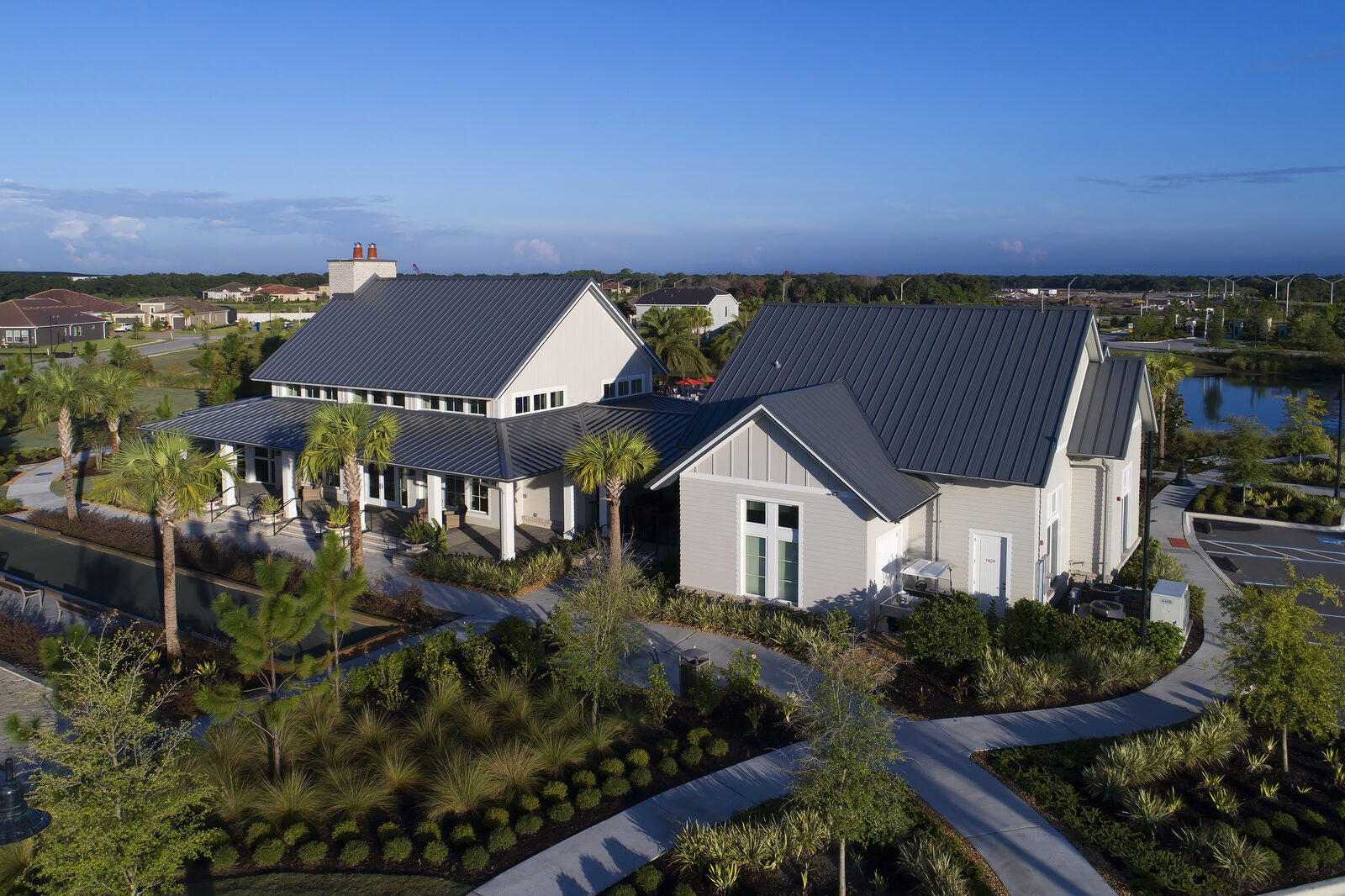
Overview
Zinc is a premium, naturally corrosion-resistant roofing metal (typically 99.995% pure zinc alloyed with small amounts of titanium and copper) used on residential standing-seam roofs, metal shingles, and architectural plate roofing. Its defining characteristic is a self-healing patina: a thin protective layer of zinc carbonate/oxide forms on the surface within roughly 6 months to 5 years of exposure (faster with more wet/dry cycling), shifting the metal from a bright silvery mill finish to a matte blue-gray or graphite-gray. When the surface is scratched or abraded, atmospheric moisture and CO2 react with the newly exposed zinc to regenerate the protective layer over the damaged area, effectively "self-healing" minor surface blemishes so they don't propagate into corrosion. Zinc is positioned as a high-end architectural product for premium residential and custom homes rather than a mainstream mass-market roofing choice.
Specifications
| Materials | Titanium zinc alloy (~99.995% pure zinc with small additions of titanium and copper) |
|---|---|
| Profiles | Standing seam (single-lock and double-lock), Metal shingles/tiles, Flat-lock/plate panels, Angled standing seam |
| Gauge / thickness | Zinc roofing sheet is specified by thickness (mm) rather than U.S. steel gauge: standard thicknesses are 0.7mm and 0.8mm, with 0.8mm commonly used for standing-seam panels subject to more mechanical stress. |
| Panel widths | Standard coil/panel widths in the roughly 400mm-600mm range, with ~530mm a common standard; narrower panels (~430mm) used for single-lock configurations. Panel lengths run up to ~10m in production but are typically limited to ~4m or less for practical handling/installation. |
| Material cost | $10–$25/sq ft |
| Lifespan | 60–100 yr |
| Wind rating | Not independently well-documented for zinc specifically in the sources reviewed; standing-seam metal systems generally (including zinc standing seam with proper clip spacing) are rated in the 140-180 mph range, though this figure is more commonly cited for steel/aluminum systems — zinc-specific third-party wind test data should be verified against the chosen manufacturer's product line. |
| Fire rating | Class A achievable when installed over an appropriate underlayment/assembly, consistent with other noncombustible metal roofing materials. |
| Hail performance | Weaker point relative to steel: as a comparatively soft metal, zinc is more susceptible to denting from hail and debris impact than standing-seam steel; heavier-gauge (0.8mm) panels perform somewhat better than 0.7mm. |
| Weight | Lightweight — roughly 1-2.5 lb per sq ft, lighter than concrete tile or slate and in a similar light range to steel/aluminum standing seam. |
| Fastener type | Concealed clip systems are standard for standing-seam zinc (no face fasteners penetrating the panel), which also accommodates thermal movement; exposed carbon-steel fasteners should be avoided in/near zinc due to galvanic corrosion risk, and hardware in contact with treated wood requires compatible, non-reactive fastener selection. |
Pros
- Genuine self-healing patina that repairs minor scratches/abrasions via natural oxidation, unlike painted metals where a scratch is a permanent coating breach
- Very long service life — most manufacturer literature (VMZINC, RHEINZINK, International Zinc Association) cites 60-100+ years, with some installations reaching 100-120 years under good conditions
- Naturally corrosion-, rust-, rot-, and pest-resistant with no factory paint/coating required to perform — the material itself is the finish
- Distinctive, sought-after aesthetic: evolves from bright silver to a soft matte blue-gray/graphite patina, popular for modern and high-end architectural residential design
- Lightweight relative to tile/slate — roughly 1-2.5 lb/sq ft, reducing structural loading concerns
- Class A fire rating achievable with appropriate underlayment, like other metal roofing
- Malleable, easy to form into complex shapes, curves, and detailing for architecturally ambitious roof geometries
- 100% recyclable and low embodied carbon relative to many building materials, a selling point in sustainability-focused markets
- Performs well in a wide range of climates including arid/desert Southwest (low humidity slows corrosion) and can resist salt-driven damage in coastal use when properly detailed
Considerations
- Most expensive mainstream residential metal roofing material — materials plus install commonly $10-25/sq ft installed vs. far less for steel
- Requires specialist/experienced installers; zinc has unique installation requirements (e.g., specific venting behind panels, expansion/contraction detailing) and general roofing crews unfamiliar with zinc can cause premature failures
- Softer metal than steel — more prone to denting from hail, foot traffic, and falling debris than standing-seam steel
- Runoff is not paint-neutral: rainwater draining off zinc carries dissolved zinc that can stain driveways, walkways, and adjacent light-colored materials (stucco, concrete, siding) over time
- Chemically incompatible with certain materials — must not directly contact copper, aluminum, treated/acidic woods (cedar, oak, larch tannins), or wet mortar/uncured concrete due to galvanic corrosion or pitting from non-neutral runoff pH
- Not recommended for unrinsed surfaces (e.g., sheltered soffits, some gutter configurations) in marine/coastal settings, where salt exposure without periodic rinsing can cause permanent staining
- Patina formation is a visible aesthetic transition period (6 months to 5 years) during which the roof looks bright/silvery before reaching its intended matte gray appearance — a consideration for homeowners wanting immediate final color
- Zinc runoff can act as a mild biocide; some jurisdictions/eco-sensitive sites require runoff collection or management
- Warranty terms are typically shorter on material finish/patina performance than the touted lifespan (commonly 30-50 years from manufacturers) versus 10-20+ year finish warranties homeowners may expect from painted steel/aluminum panels
- Because zinc is an unpainted/natural-finish metal, it sits outside the paint-coating value proposition (PVDF/Kynar, SMP) that differentiates coated steel and aluminum roofing products
Where Zinc Roofing (Residential) performs best
Climates
- Arid/desert climates (low humidity slows corrosion, extends performance)
- Temperate humid climates with regular wet/dry cycling (accelerates healthy patina formation)
- Coastal/marine settings, with caution — good on frequently rain-washed surfaces, but not recommended for sheltered/unrinsed surfaces like some soffit and gutter configurations where salt can accumulate
Home Styles
- Modern/contemporary architecture
- High-end custom homes
- Architect-designed residences with complex rooflines
- Farmhouse-modern and industrial-modern styles seeking a matte gray metal aesthetic
Sherwin-Williams Finish
Low/not applicable in the traditional sense — zinc's value proposition is its natural, uncoated, self-healing patina finish, which is the opposite selling point of a PVDF/Kynar or SMP factory-applied coated steel/aluminum panel (MetalVue's core category). Zinc is not typically sold as a painted/coated substrate; positioning it within a coatings-brand roofing line would require framing it as a natural/premium alternative material rather than a coating-differentiated SKU, or focusing coatings messaging on complementary components (flashing, trim, gutters) rather than the zinc field panel itself.
Look & Aesthetics
Begins as a bright, mirror-like silvery metal and transitions over roughly 6 months to 5 years (faster with more wet/dry cycling) into a matte blue-gray or graphite-gray patina — pre-weathered/pre-patinated zinc products are available from some manufacturers for homeowners who want the final look immediately rather than waiting through the visible transition period. The muted, non-reflective patina is strongly associated with modern, minimalist, and high-end architectural residential design.
What Drives Installed Cost
Multiple 2025-2026 cost guides (Modernize, HomeGuide, Angi) converge on roughly $10-$25 installed per sq ft, with material alone around $5-$10/sq ft and labor roughly $5-$10/sq ft (labor rises 20-30% for steep-pitch roofs and up to 40% for multi-story homes due to specialist crew requirements). A typical 2,000 sq ft roof runs about $20,000-$50,000 total, averaging near $32,000 — positioning zinc as one of the priciest metal roofing options, comparable to or above copper in some markets and well above steel/aluminum standing seam.
Warranty
Manufacturer material warranties are commonly in the 30-50 year range (e.g., RHEINZINK offers a 40-year guarantee; VMZINC's standard direct material warranty is around 10 years but extends to roughly 30 years when installed by an approved/certified installer, and up to 50 years can be arranged project-by-project). These are shorter than the material's claimed 60-100+ year functional lifespan — the warranty covers material defects/perforation, not the full expected service life. Homeowners should confirm whether a warranty requires a certified installer network, since zinc's specialized installation practices materially affect long-term performance and warranty validity.
Get matched with a certified MetalVue installer
Compare Zinc Roofing (Residential) pricing and options with a free, no-obligation estimate.