
Climate & Weather in South Carolina
South Carolina has a humid subtropical climate statewide (subtropical highland in the Upstate/Blue Ridge foothills), with hot, humid summers and mild winters. The state divides into three zones: the Atlantic Coastal Plain (roughly two-thirds of the state, including the Lowcountry, Grand Strand, and Sea Islands — flat, sandy, marsh-laced, hurricane- and salt-exposed), the Piedmont (rolling terrain, Columbia/Midlands and inland areas), and the Blue Ridge/Upstate (Greenville-Spartanburg foothills, occasional ice and heavier winter weather). Coastal SC is directly in the Atlantic hurricane corridor; inland/upstate SC sees more severe thunderstorms, tornadoes, and hail. UV exposure and humidity are high statewide, driving heat/moisture-related roof degradation and algae/mildew staining on traditional roofing.
Weather Perils to Plan For
Hurricanes / tropical storms & coastal high wind
Coastal counties (Charleston, Beaufort, Horry/Myrtle Beach, Georgetown) fall in high wind-speed design zones under the SC Residential Code (ultimate design wind speed Vult per Figure R301.2(2)); code triggers enhanced wind design once Vult reaches 140 mph. Quality metal roof systems are rated for gusts up to ~140 mph (equivalent to an F2 tornado) per Metal Roofing Alliance.
Severe thunderstorms / hail
Inland Piedmont/Upstate SC sees frequent severe thunderstorm and hail activity in spring; hail-resistant (Class 4) metal panels are a differentiator vs. asphalt.
Tornadoes
SC lies at the edge of the Dixie Alley/Southeast tornado corridor; tornadoes accompany both landfalling tropical systems and spring squall lines, especially in the Midlands and Pee Dee regions.
Coastal salt air / corrosion
Lowcountry and Grand Strand homes face chronic salt-air exposure; aluminum or marine-grade coated steel (e.g., Galvalume with PVDF/Kynar finishes) is recommended over bare/standard galvanized steel within several miles of the coast.
Heavy rain / flooding
Tropical systems and slow-moving storms (e.g., historic Oct. 2015 and Hurricane Florence 2018 flooding) bring extreme rainfall; metal roofing's near-impermeability to wind-driven rain is a key sell versus shingles.
High humidity / algae & moss growth
Humid subtropical conditions promote algae streaking and moss on traditional shingle/wood roofs; factory-coated metal resists this better than asphalt.
Wildfire / WUI
Not a primary peril for most of SC (unlike CA/CO); limited relevance mainly in drought-stressed wooded Upstate/Sandhills areas, but Class A fire rating of metal roofing is still a selling point for standalone rural or forested lots.
Heavy snow load
Snow is rare and light in SC even in the Upstate; not a significant structural design driver, though metal's snow-shedding helps during occasional winter storms/ice events.
High UV / solar heat
Long, intense summer sun drives cooling costs and asphalt shingle degradation; reflective/cool-roof-rated metal coatings reduce attic heat gain.
Recommended Metal Roof Types
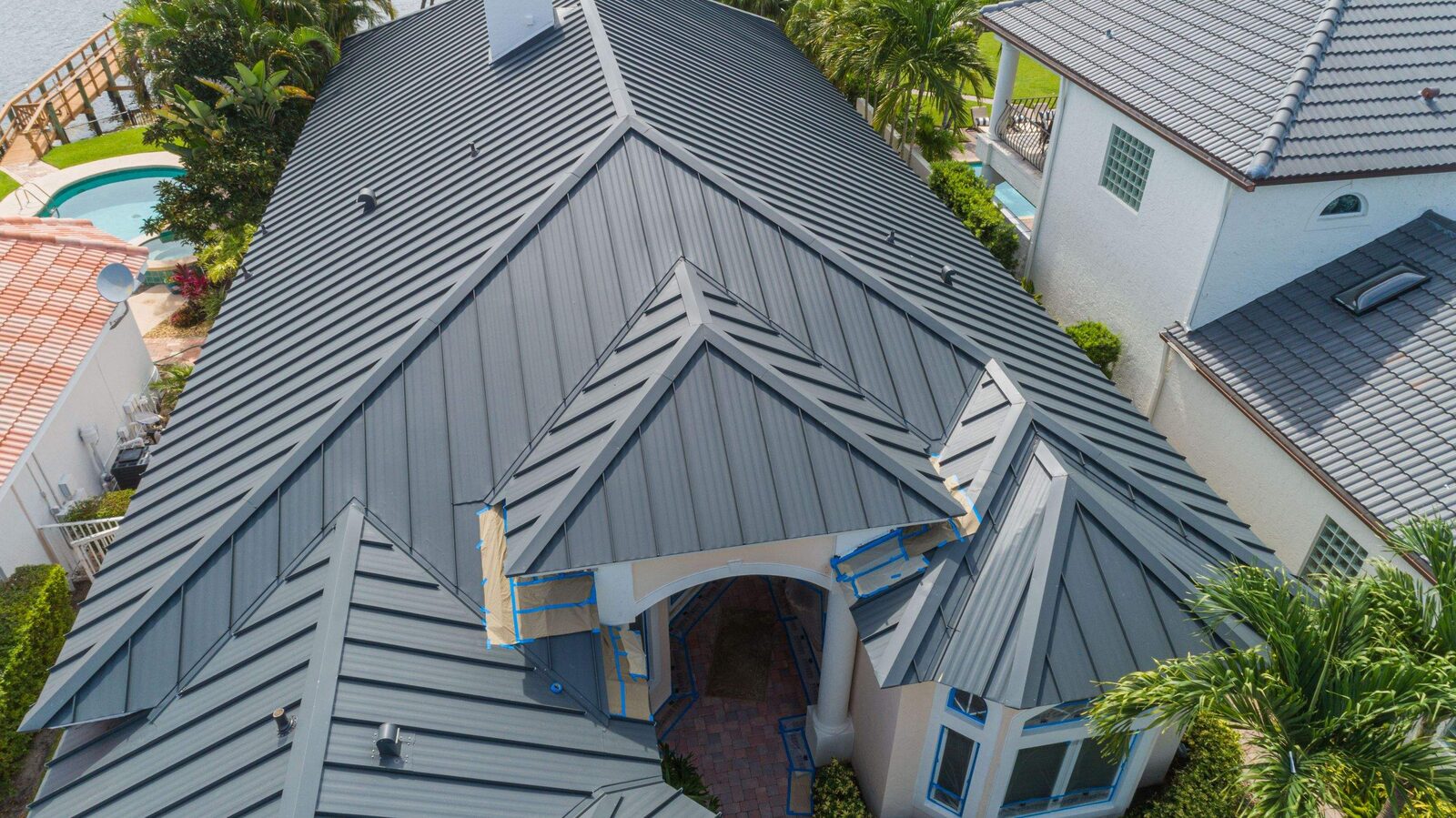
Standing seam steel (concealed-fastener, Galvalume or steel substrate with PVDF/Kynar coating)
Highest wind-uplift performance for hurricane-prone coastal counties (Charleston, Horry, Beaufort, Georgetown); code-favored for high Vult zones; best watertightness for wind-driven rain.
Standing seam aluminum
Preferred within a few miles of the ocean/marsh for superior corrosion resistance versus steel in chronic salt-air exposure (Lowcountry/Grand Strand barrier islands).
Stone-coated steel shake/shingle panels
Popular retrofit choice in historic districts and traditional neighborhoods (Charleston, Columbia, Greenville) wanting shingle or shake aesthetics with metal's wind/hail/fire performance.
Exposed-fastener corrugated/R-panel steel
Lower-cost option common on rural Piedmont/Upstate homes, outbuildings, and budget-conscious re-roofs; less ideal directly on the coast due to fastener corrosion risk.
Building Code, Wind & Fire
| Building Code Notes | South Carolina uses IRC/IBC-based codes as adopted and amended by the SC Department of Labor, Licensing and Regulation (LLR) Building Codes Council (2021 South Carolina Residential Code cycle). Wind design requirements are governed by Figure R301.2(2) ultimate design wind speed maps, with coastal jurisdictions designated at higher Vult and, at/above 140 mph, requiring shift from prescriptive to full wind-design-category engineering. Local building officials (especially in Charleston, Horry, Beaufort, and Georgetown counties) may impose stricter roof-covering, deck-attachment, and wind-borne-debris provisions than the state minimum; roofing contractors should verify jurisdiction-specific amendments and any FORTIFIED/Safe Home program documentation requirements before installation. |
|---|---|
| Wind Requirements | South Carolina Residential Code (2021 IRC-based, per SC LLR/Building Codes Council) sets ultimate design wind speed (Vult) via Figure R301.2(2), varying by location — coastal counties carry the state's highest design wind speeds, with the code stating jurisdictions at or above 140 mph Vult must move from prescriptive wind provisions into full wind design category engineering. Roofing systems in these zones require tested, rated uplift resistance (per ASCE 7 and manufacturer/UL 580 or similar wind-uplift testing), proper fastening schedules, and adherence to local building official amendments; some coastal jurisdictions (e.g., Charleston, Horry, Beaufort counties) impose stricter wind-borne debris and roof-covering requirements than inland/upstate areas. |
| Fire Requirements | Standard SC building code (IRC/IBC as adopted by SC LLR Building Codes Council) requires roof coverings to meet minimum fire-classification ratings per ASTM E108/UL 790; metal roofing systems are inherently Class A fire-rated, the highest classification, which exceeds baseline SC code requirements. Wildfire/WUI-specific fire codes are not broadly applicable in SC as they are in western states, but Class A rating remains a value proposition for rural/forested Upstate and Sandhills properties and for insurance underwriting. |
Insurance & Adoption
Typical Installed Cost
Approximate installed cost ranges commonly cited for residential metal roofing (materials + labor, national ranges applicable to SC, with coastal SC often at the higher end due to corrosion-resistant coatings and hurricane-rated installation detailing): exposed-fastener corrugated/screw-down steel panels roughly $6-$10/sq ft; standing seam steel (concealed fastener) roughly $9-$16/sq ft; standing seam aluminum roughly $10-$18/sq ft (coastal-recommended); stone-coated steel roughly $9-$14/sq ft; copper and zinc premium standing seam roughly $18-$30+/sq ft.
Popular Metal Roof Colors in South Carolina
- Charcoal gray / graphite
- Matte black
- Bronze / dark bronze
- Colonial red (traditional Lowcountry tin-roof aesthetic)
- Forest/hunter green
- Weathered/galvalume silver (mill-finish look)
- Copper patina tones (aged copper accents on porches/dormers)
- Slate blue-gray
Common Home Styles
- Lowcountry / coastal cottage (elevated pier or crawlspace foundations, deep porches, metal roofs historically standard in Charleston/Beaufort)
- Traditional Southern farmhouse and craftsman
- Charleston single house (historic peninsula infill)
- Ranch and split-level (widespread suburban Midlands/Upstate stock)
- New-construction traditional/transitional in Charleston, Greenville, Columbia, Myrtle Beach suburbs
- Coastal new-build and raised beach house along the Grand Strand and Sea Islands
- Some historic Piedmont mill-village and bungalow housing in Upstate cities
Metro Areas We Serve in South Carolina
Aiken
Aiken County, Edgefield County (small part of North Augusta)
Beaufort
Beaufort County
Charleston (Charleston-North Charleston MSA)
Charleston County, Berkeley County, Dorchester County
Columbia
Serving Columbia and surrounding communities.
Florence
Florence County, Darlington County
Greenville
Greenville County, Pickens County, Anderson County
Hilton Head Island–Bluffton, SC Metropolitan Statistical Area (Lowcountry)
Beaufort County, Jasper County
Myrtle Beach / Grand Strand (Myrtle Beach-Conway-North Myrtle Beach, SC MSA + Georgetown County CSA)
Horry County, Georgetown County
Rock Hill (Rock Hill–Fort Mill), part of the Charlotte-Concord-Gastonia, NC-SC Combined Statistical/Metropolitan Area
York County, Lancaster County
Spartanburg
Spartanburg County, Union County
Get a Free Metal Roofing Estimate in South Carolina
Tell us about your project and a certified Sherwin MetalVue professional in your area will follow up with a free, no-obligation estimate.
Sherwin-Williams is not liable for the conduct, performance, or workmanship of any contractor.